
The Looney Tunes Show, The Experiment That Time Had to Catch Up With
- Corey M. Floyd

- May 18
- 5 min read
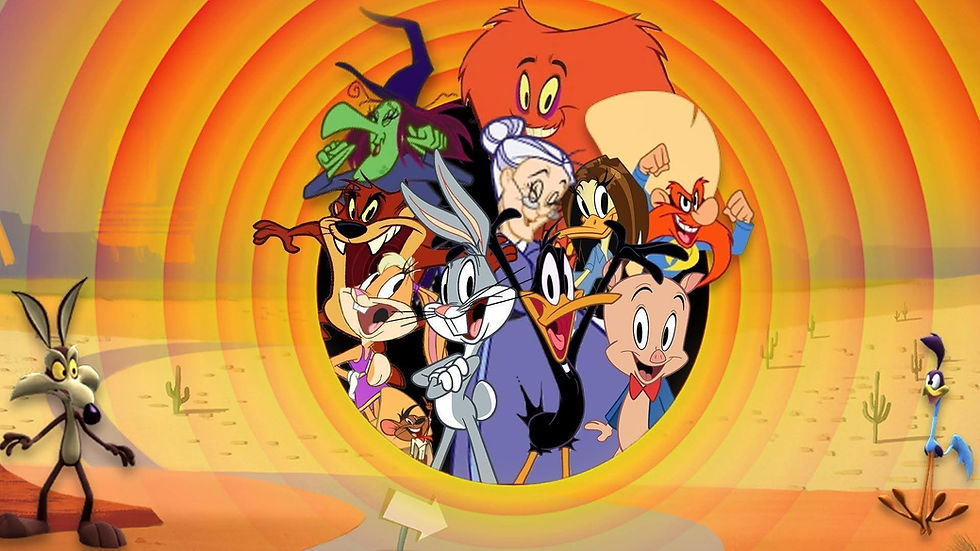
Fifteen years ago, The Looney Tunes Show arrived with the quiet confidence of something that didn’t quite realize how strange it looked from the outside. On paper, it sounded simple enough: bring back the most iconic cartoon characters ever created and give them a fresh coat of paint. But what landed on screens wasn’t a reboot in the traditional sense. It was a reinvention that felt less like a return and more like a sideways step into unfamiliar territory.
Gone were the deserts, the dynamite, the fourth-wall winks. In their place? A suburban neighborhood, complete with tidy lawns, social obligations, and the creeping anxiety of adulthood. It was as if someone had taken the DNA of Looney Tunes and run it through a sitcom filter, trading chaos for character study. For audiences raised on the kinetic madness of the originals, it felt like watching a thunderstorm get bottled and placed on a kitchen shelf.

At the center of it all were Bugs Bunny and Daffy Duck, but not quite the versions audiences remembered. Bugs, once the ultimate trickster, became the steady anchor, a carrot-chomping straight man navigating the absurdity of everyday life with quiet, almost surgical precision. Daffy, on the other hand, evolved into something far more volatile. No longer just a jealous foil, he became a full-blown walking contradiction, equal parts ego, insecurity, and catastrophic decision-making.
Their dynamic shifted accordingly. This wasn’t hunter versus hunted or rival versus rival. This was roommate versus roommate, a domestic cold war fought over chores, money, and dignity. The humor didn’t come from anvils falling out of the sky. It came from the slow realization that Daffy would absolutely ruin his own life just to prove a point, and Bugs would let him do it, watching with the patience of someone who has seen this exact disaster play out before.

This tonal pivot was the show’s boldest move, and also its biggest hurdle. For decades, Looney Tunes thrived on speed and spectacle, on the kind of visual anarchy that could land a joke in seconds. The Looney Tunes Show asked viewers to slow down, to sit with conversations, to find humor not in what exploded but in what simmered. It was less about impact and more about rhythm, a deliberate shift that traded slapstick for something closer to satire.
What makes the show fascinating in hindsight is how deeply it commits to this approach. Instead of treating its characters as vessels for gags, it treats them as people, exaggerated, absurd people, but people nonetheless. Daffy’s schemes aren’t just setups for punchlines; they’re expressions of his need for validation. Bugs’ calm demeanor isn’t just a comedic contrast; it’s a form of control, a way of navigating a world that constantly threatens to spiral into nonsense.

And then there’s Lola Bunny, who might be the show’s most inspired reinvention. Voiced with a kind of fearless unpredictability, this version of Lola is a whirlwind of tangents, impulses, and unfiltered thoughts. She doesn’t enter scenes so much as she detonates them, sending conversations careening into unexpected territory. Where other characters operate within the show’s carefully constructed rhythms, Lola breaks them entirely, creating moments that feel alive in a way that’s almost impossible to script.
Her presence highlights one of the show’s quiet strengths: its willingness to embrace discomfort. Conversations stretch longer than expected. Jokes linger just enough to feel awkward. Characters reveal more of themselves than they probably should. It’s comedy that leans into the unease of real interaction, where timing isn’t always perfect and people don’t always say the right thing. In a franchise built on precision, that looseness feels almost rebellious.
But if the show was so confident in its identity, why didn’t it land the way it should have?

The answer lies in expectations. By carrying the Looney Tunes name, the series inherited a legacy that came with very specific assumptions. Audiences expected chaos, speed, and a certain kind of irreverence. What they got instead was something quieter, more introspective, and, at times, more biting. It wasn’t that the humor was absent; it was that it operated on a different frequency. This mismatch created a kind of cultural static. Younger viewers, drawn in by the brand, found a show that didn’t cater to their expectations of cartoon energy. Older viewers, who might have appreciated its character-driven approach, often dismissed it as a departure from what made Looney Tunes special. The result was a series that existed in an awkward middle space, not fully embraced by either audience.

And yet, beneath that initial confusion, there was something remarkably sharp. The Looney Tunes Show is, at its core, a satire of modern life. It takes the absurdities of adulthood, career anxiety, social performance, and financial instability and refracts them through characters who are hilariously ill-equipped to handle them. Daffy is chasing status despite lacking the skills to sustain it. Bugs are maintaining control in a world that constantly tests his patience. The supporting cast, from Porky’s anxious professionalism to Yosemite Sam’s attempts at legitimacy, all orbiting the same central idea: that adulthood is a performance, and most people are improvising.
Even the show’s structure reflects this tension. Episodes weave together multiple elements, a central narrative, musical interludes, and shorter segments that echo the franchise’s past. At times, it feels disjointed, like the show is negotiating between what it was and what it wants to be. But there’s something fitting about that fragmentation. It mirrors the identity crisis at the heart of the series, a constant push and pull between legacy and reinvention.

In the years since its cancellation, the conversation around The Looney Tunes Show has shifted. Freed from the weight of expectation, it’s easier to see what the series was trying to do, and how successfully it achieved it. What once felt like a misstep now feels like a deliberate experiment, one that prioritized character over spectacle and subtlety over immediacy.
Rewatching it now, the humor lands differently. The pacing feels intentional rather than sluggish. The character dynamics reveal layers that were easy to miss the first time around. It’s a show that rewards patience, that asks viewers to meet it on its own terms rather than judging it against the past.

In many ways, its reevaluation mirrors the trajectory of other cult favorites, projects that arrived out of sync with their cultural moment only to find appreciation later. There’s a growing recognition that The Looney Tunes Show didn’t fail because it misunderstood its source material. It succeeded because it understood it too well, recognizing that the essence of these characters wasn’t just in their antics but in their personalities.
By grounding them in a more structured world, the show exposed those personalities in new ways. It asked what happens when chaos has consequences, when impulsiveness collides with routine, when characters known for breaking reality have to live within it. The answers aren’t always explosive, but they are consistently revealing. Ultimately, The Looney Tunes Show stands as a reminder that reinvention is rarely comfortable. It challenges audiences to let go of what they expect and engage with what’s actually in front of them. That’s a difficult ask, especially for a property as iconic as Looney Tunes. But it’s also what makes the show worth revisiting.
It may not deliver the rapid-fire insanity of the originals, but it offers something else entirely: a slower, sharper, and surprisingly insightful look at characters who, even after decades, still have new stories to tell. And sometimes, that quiet evolution is far more daring than any explosion.


Comments