
Why IT: Welcome to Derry Works — and Why Its Racism Is the Point
- Corey M. Floyd

- Dec 30, 2025
- 4 min read

Horror has always been about more than monsters. At its best, it uses fear as a language—one that speaks to social rot, buried guilt, and the things communities refuse to confront. IT: Welcome to Derry, which understands this tradition deeply, and that’s why it succeeds where so many prequel series fail. It doesn’t exist just to explain lore or mine nostalgia; it exists to interrogate the soul of a town that keeps choosing cruelty over accountability. IT: Welcome to Derry is effective not because it shows us Pennywise again, but because it shows us the environment that allows Pennywise to thrive. And central to that environment—unavoidably, deliberately—is racism.

Most prequels answer questions no one needed answered. Welcome to Derry, which does the opposite: it reframes the entire mythology of IT by shifting the focus away from a singular evil and toward a systemic one. Pennywise isn’t the beginning of the horror—he’s the symptom. By setting the story decades earlier, the show reveals how violence, hatred, and willful ignorance are baked into the town’s history. Derry isn’t cursed because a monster lives beneath it; a monster lives beneath it because Derry keeps feeding it. This is a crucial distinction, and it’s what elevates the show from franchise extension to meaningful horror storytelling.

One of the most talked-about aspects of Welcome to Derry is its unflinching depiction of racism—especially toward Black residents and other marginalized groups. Importantly, the show does not treat racism as a “background detail” or a momentary obstacle for sympathetic characters. It treats racism as a core mechanism of the town’s violence.

Racist harassment, police indifference, institutional neglect, and generational bigotry are not side plots—they are the groundwork. The show makes it clear that certain people in Derry have always been disposable, and that this disposability is what creates the emotional decay Pennywise feeds on.
This is uncomfortable viewing by design. The show refuses to sanitize the past or soften its edges for audience comfort. Racism isn’t portrayed as the problem of a few bad people; it’s shown as a communal failure, quietly upheld by silence, apathy, and tradition. That choice matters. Horror that avoids social specificity often feels hollow. Welcome to Derry, which understands that true fear doesn’t come from jump scares—it comes from recognition.

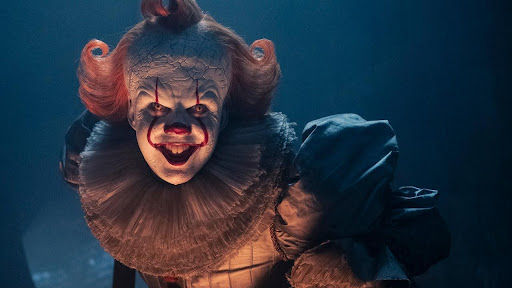
In earlier adaptations of IT, Pennywise often functions as an external force: something alien, predatory, and unknowable. Welcome to Derry reframes him as something far more unsettling. He is still supernatural, still monstrous—but he is also deeply reactive. The show suggests that Pennywise doesn’t just arrive during moments of violence; he is invited by them. Racial terror, mob violence, and institutional cruelty aren’t interruptions to the horror narrative—they are the fuel. Pennywise mirrors the town’s values back at it in exaggerated, grotesque form. This approach aligns with the original thematic undercurrent of IT, but the series makes it more explicit, more pointed, and more contemporary in its framing. Derry isn’t innocent. It never was.

One of the show’s smartest recurring ideas is Derry’s selective memory. Horrific events happen, people die, lives are ruined—and then the town moves on. Not because it heals, but because it refuses to look too closely. This cultural amnesia is where racism and horror intersect most powerfully. The same mechanisms that allow racial violence to be ignored or rewritten also allow Pennywise to continue existing. The show draws a clear parallel between historical erasure and supernatural recurrence: when a community refuses accountability, evil doesn’t disappear—it cycles. By tying Pennywise’s longevity to Derry’s moral cowardice, Welcome to Derry argues that monsters don’t need to be killed if they’re constantly being fed.
There’s a fine line between depicting racism and exploiting it, and Welcome to Derry largely stays on the right side of that line. The show doesn’t aestheticize racial violence or use it as cheap emotional shorthand. Instead, it contextualizes it—showing how it shapes daily life, power structures, and survival strategies

.
Characters aren’t defined solely by their suffering, but their suffering isn’t minimized either. The horror doesn’t come from “bad things happening to good people”; it comes from watching a system repeatedly fail the same people and call it normal. This honesty gives the show weight. It trusts its audience to sit with discomfort rather than look away, and that trust pays off in storytelling depth.

What ultimately makes IT: Welcome to Derry a great show is that it understands horror as a moral genre. It doesn’t just ask “what are you afraid of?”—it asks “what are you complicit in?”The racism depicted in the series isn’t an add-on or a modern rewrite; it’s a lens through which the town’s entire mythology comes into focus. Pennywise isn’t just a clown monster. He is the embodiment of what happens when cruelty becomes tradition and violence becomes routine. In that sense, Welcome to Derry doesn’t dilute the legacy of IT—it sharpens it.
Final Thoughts: Derry Deserves Its Monster
IT: Welcome to Derry succeeds because it refuses to let Derry off the hook. It doesn’t pretend the town was ever innocent. It doesn’t blame everything on cosmic evil and call it a day. Instead, it shows how communities build their own nightmares, brick by brick, prejudice by prejudice, silence by silence. The racism in the show isn’t there to shock—it’s there to explain. And that explanation makes the horror hit harder than any jump scare ever could. Because the most terrifying idea the show offers isn’t that Pennywise exists. It’s that he belongs there.
What do you think is more frightening: Pennywise himself—or the town that keeps inviting him back? Let’s talk in the comments.


Comments